Description
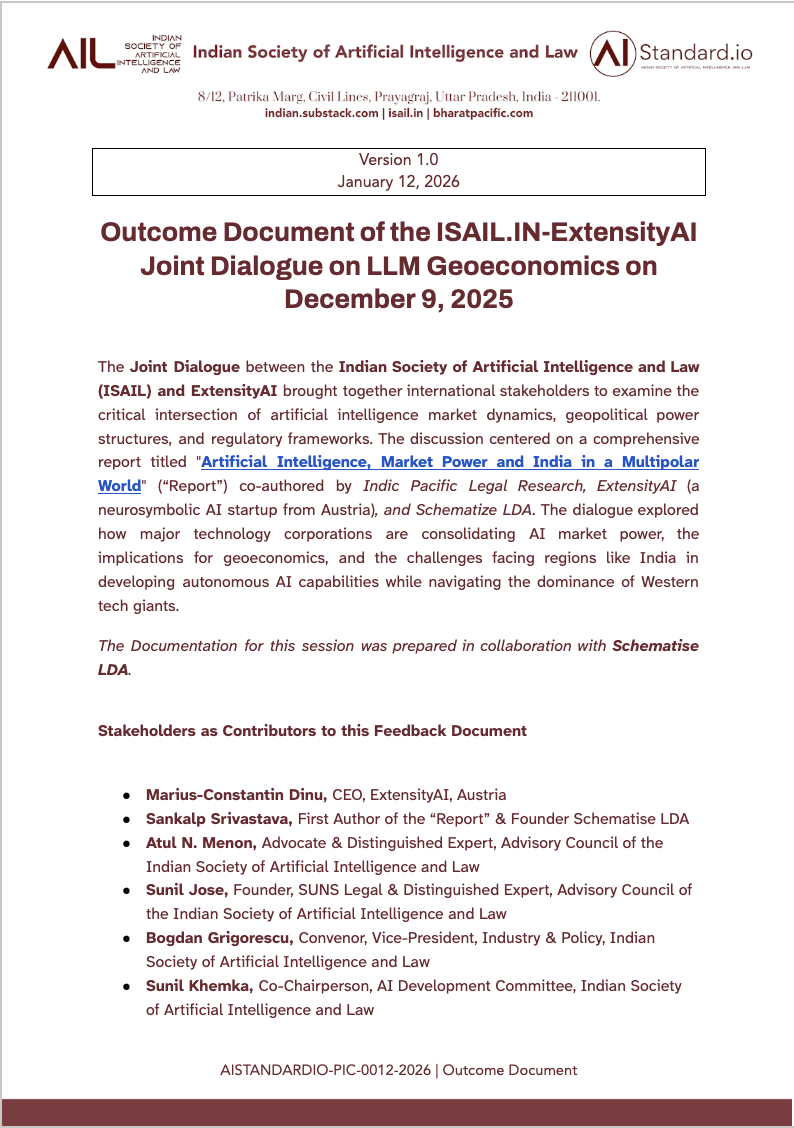
The Joint Dialogue between the Indian Society of Artificial Intelligence and Law (ISAIL) and ExtensityAI brought together international stakeholders to examine the critical intersection of artificial intelligence market dynamics, geopolitical power structures, and regulatory frameworks. The discussion centered on a comprehensive report titled “Artificial Intelligence, Market Power and India in a Multipolar World” (“Report”) co-authored by Indic Pacific Legal Research, ExtensityAI (a neurosymbolic AI startup from Austria), and Schematize LDA. The dialogue explored how major technology corporations are consolidating AI market power, the implications for geoeconomics, and the challenges facing regions like India in developing autonomous AI capabilities while navigating the dominance of Western tech giants.
The Documentation for this session was prepared in collaboration with Schematise LDA.
Stakeholders as Contributors to this Feedback Document
- Marius-Constantin Dinu, CEO, ExtensityAI, Austria
- Sankalp Srivastava, First Author of the “Report” & Founder Schematise LDA
- Atul N. Menon, Advocate & Distinguished Expert, Advisory Council of the Indian Society of Artificial Intelligence and Law
- Sunil Jose, Founder, SUNS Legal & Distinguished Expert, Advisory Council of the Indian Society of Artificial Intelligence and Law
- Bogdan Grigorescu, Convenor, Vice-President, Industry & Policy, Indian Society of Artificial Intelligence and Law
- Sunil Khemka, Co-Chairperson, AI Development Committee, Indian Society of Artificial Intelligence and Law
- Arletta Gorecka, Lecturer, Glasgow International College & Distinguished Expert, Advisory Council of the Indian Society of Artificial Intelligence and Law
- Abhivardhan, President, Indian Society of Artificial Intelligence and Law (Moderator)
- Chirkankshit Bulani, Rajiv Gandhi National University of Law, Patiala (Rapporteur of the Joint Dialogue & Editor of this Document)
The session built upon ongoing global discussions about AI sovereignty, data governance, and the need for proportional regulatory frameworks that balance innovation with accountability. Participants examined the technical limitations of current generative AI systems, the shift toward trade secrets in IP protection, and the potential for alternative approaches such as neurosymbolic AI to address fundamental algorithmic challenges.


![The Legal and Ethical Implications of Monosemanticity in LLMs [IPLR-IG-008]](https://indopacific.app/wp-content/uploads/2024/09/IPLR-IG-008-300x300.gif)
![Artificial Intelligence and Policy in India, Volume 4 [AIPI-V4]](https://indopacific.app/wp-content/uploads/2024/04/AIPI-V4-2024-300x300.gif)